For Mid- to Senior-Level Professionals Who Secretly Wonder If They're As Good As Everyone Thinks
The Higher You Climb, The Worse It Gets — And There's A Scientific Reason Why
Groundbreaking 2023 research just revealed the hidden mechanism keeping high-achievers trapped in self-doubt — and why every promotion, raise, and achievement has been making it worse, not better. The PRISM Method™ corrects this in just 14 days.
The Scientific Reason Why
The Escalation Curve
The more successful you become, the worse imposter syndrome gets.
71%
of US CEOs experience
imposter syndromeKorn Ferry Workforce Report, 2024
One-time payment. No subscription. No recurring charges.
Scroll down to see exactly why what you've tried before hasn't worked — and what actually will.
You've Achieved More Than Most People Ever Will. So Why Does It Still Feel Like You're Faking It?
You got the degree. You earned the title. You've delivered results that speak for themselves.
And yet…
Every morning, before your feet hit the floor, there's that knot in your stomach. That low hum of dread asking: "Is today the day they figure out I don't belong here?"
You've built a career that impresses everyone around you — but on the inside, you're running a completely different story.
Sound familiar?
If three or more of those hit close to home, keep reading.
Because what you're about to learn completely changes the game — not by giving you more motivational advice, but by explaining the exact biological mechanism that's keeping you stuck.
Here's what nobody warns you about when you work this hard to get here:
The more successful you become, the worse this gets.
Not better. Worse.
You thought the next promotion would finally quiet the voice. It didn't.
You thought the high-visibility project — the one you pulled off brilliantly — would finally prove you belonged. It didn't.
You thought reaching senior level, or director, or executive would make you feel like you'd arrived.
Instead: a bigger pedestal means a further fall. More eyes watching means more chances to be "exposed." Higher stakes mean the voice gets louder, not quieter.
"Every promotion poured gasoline on the fire."
That's not just your experience. Researchers have documented this exact phenomenon — and for the first time, there is a scientific explanation for why it happens and a structured system to reverse it.
The Calibration Gap
Same person. Two completely different readings.
What your colleagues see
What you experience
Here's What No One Has Told You About Why This Keeps Happening — No Matter What You Try
You've probably been told some version of this:
"Challenge the negative thoughts." "Keep a wins journal." "Fake it till you make it." "Just be more confident."
And if that advice made you want to throw a book across the room, your frustration is completely warranted.
Because those suggestions are based on a fundamental misunderstanding of the problem.
Imposter syndrome isn't about negative thinking. It isn't about low self-esteem. It isn't a personality flaw or a sign that you lack resilience.
It's a measurement error.
Introducing: The Miscalibration Trap
In a landmark 2023 study, researchers Gadsby & Hohwy discovered something that changes everything we thought we knew about professional self-doubt:
The brains of imposter syndrome sufferers contain a metacognitive calibration error — meaning the internal system your brain uses to assess your own competence is reading your abilities 30% to 50% lower than your actual performance.
Think of it like a broken thermometer.
The room is 75 degrees. Everyone in it is comfortable. But your thermometer reads 45 — and every decision you make is based on that reading.
You dress and prepare for cold. You expect cold. You might even feel cold. Not because the room is cold, but because your instrument says it is.
That's your brain right now.
It's not that you haven't gathered enough evidence that you're competent. You have mountains of it.
The problem is that the instrument measuring that evidence is broken.
That's why the promotions didn't help. That's why the praise didn't land. That's why the record-breaking quarter didn't make you feel any more secure.
You weren't feeding it through a healthy assessment system. You were running it through a thermometer set 30 degrees too cold.
But Here's Where It Gets Even More Interesting — And More Cruel
The broken thermometer is only half the story.
You've been compensating for it your entire career.
You prepare for 6+ hours what should take 2. You say yes to every request so no one questions whether you deserve to be there. You work twice as hard as your peers and accept it as normal.
These are your protective behaviors — and they feel like they're keeping you safe.
But they're not. They're keeping you trapped.
Here's why: every time you over-prepare and succeed, your brain doesn't conclude "I am competent."
Your brain concludes: "I need to over-prepare to succeed."
The success gets credited to the extra effort. Not to your ability.
So the belief that you're secretly inadequate — that without the extra effort you'd be exposed — is reinforced again. And the cycle locks tighter.
This is The Protection Paradox.
Therapy gave you insight into this pattern. Books gave you a name for it. Workshops told you it was common.
None of them broke the cycle — because none of them addressed the broken thermometer.
That's what The PRISM Method™ does.
It's Not That You Didn't Try Hard Enough. It's That Every Solution You've Tried Was Aimed at the Wrong Target.
Let's be direct about the landscape of existing solutions — because if you've been down any of these roads, you deserve an honest explanation of why they didn't stick.
Therapy
Gave you language for the experience. Helped you process where it came from. But traditional therapy is a weekly event — just 4 consolidation cycles per month. And as you'll see shortly when we break down exactly what consolidation cycles are and why they matter, those six-day gaps between sessions quietly undo much of the progress. It addresses the content of your thoughts, not the operating system running them. And it takes months or years to produce meaningful change in a professional context.
Self-Help Books
"The Secret Thoughts of Successful Women." "Own Your Greatness." All valuable for raising awareness. But awareness doesn't rewire the brain. You can understand exactly what imposter syndrome is and still wake up at 3am convinced you're about to be exposed. Knowing the diagnosis doesn't fix the instrument.
Mantras & Affirmations
"I am capable. I am enough. I deserve this." Repeated daily into a mirror. You already know these alone don't work. Because you're trying to overwrite a measurement error with positive language — and your brain, quite correctly, rejects language it knows isn't consistent with what it's measuring. It's not that you need more self-belief. You need accurate measurement.
Workshops & Lunch-and-Learns
90 minutes. Some relief, some solidarity, then back to your desk. One-time events produce exactly one consolidation cycle in your brain — and as you'll see shortly when we break down exactly what they are and why they matter — the neural pathways established over years quietly reassert themselves in the days that follow.
Executive Coaching ($1,500–$5,000+)
Effective for many things. But even quality coaching is typically bi-weekly — slow, expensive, and not specifically calibrated to dismantle the Protection Paradox.
Wins Journals
You've probably tried this one. You wrote down your accomplishments for a week, maybe two. And you'll notice it provided temporary relief — but eventually your brain found reasons to discount every entry. ("That one was luck." "Anyone could have done that.") Because the journal addresses the content of the evidence. Not the broken system evaluating it.
"We've diagnosed it, discussed it — but stalled between awareness and action."
That gap — between knowing you have imposter syndrome and actually rewiring the pattern — is exactly what The PRISM Method™ was built to close.
This Isn't a Self-Help Framework Someone Built From Personal Experience. It's What Happens When You Take Three Separate Bodies of Peer-Reviewed Science and Finally Connect the Dots.
For decades, the research on imposter syndrome existed in fragments.
Psychologists understood the cycle. Neuroscientists understood sleep consolidation. Metacognition researchers understood calibration errors. But no one had built a structured intervention that pulled all three together into a coherent, sequenced system — one designed specifically for the professional context where imposter syndrome is most acute and most costly.
That gap is what The PRISM Method™ was built to close.
Here's where the science comes from, and why combining it matters.
The Calibration Error
Source: Gadsby & Hohwy (2023), Metacognitive Calibration Research
In 2023, researchers Gadsby and Hohwy published findings that reframed the entire conversation around professional self-doubt.
Their work demonstrated that imposter syndrome isn't a confidence deficit or a thinking pattern problem. It's a metacognitive calibration error — a systematic malfunction in the brain's internal self-assessment mechanism. Professionals experiencing imposter syndrome don't just feel less competent than they are. Their brains are actively and consistently measuring their competence 30%–50% below their actual performance level.
This is a measurement instrument problem. Not a belief problem. Not a mindset problem.
The implication is significant: you cannot think your way out of a measurement error. Affirmations, journaling, cognitive reframing — these approaches work on the content being measured. None of them fix the instrument doing the measuring. Which is why no amount of evidence, accomplishment, or praise changes how you feel inside.
The Self-Reinforcing Trap
Source: Dr. Pauline Clance (1985), The Impostor Cycle; Adrian Wells, Ph.D., Cognitive Attentional Syndrome
Dr. Pauline Clance — the researcher who first identified and named imposter syndrome in 1978 — documented a pattern that explains why the condition doesn't just persist, but strengthens over time.
Every professional with imposter syndrome develops compensatory behaviors: over-preparation, perfectionism, people-pleasing, working harder than necessary. These feel protective. They feel like they're keeping you safe.
But they're the mechanism of the trap.
When you over-prepare and succeed, your brain doesn't conclude "I am competent." It concludes "I needed to over-prepare to succeed." The success gets credited to the extra effort — which reinforces the belief that without it, you'd fail. The very strategies you use to cope are the bars of the cage.
Adrian Wells' Cognitive Attentional Syndrome framework adds a further layer: this isn't a conscious process. There is an automatic gating mechanism in the brain — operating below conscious awareness — that is constantly scanning for "exposure events." You've likely come to believe (subconsciously) that this vigilance is what makes you successful. That if you stopped monitoring for threats, you'd actually fail.
This is why insight alone doesn't break the pattern. You can read every book on imposter syndrome, understand the cycle perfectly, and still be running it — because the mechanism operates faster than conscious awareness. Awareness doesn't interrupt an automatic process.
Wells' Metacognitive Therapy framework has been peer-reviewed and RCT-tested to outperform standard CBT for this exact reason: it addresses the operating system, not just the thoughts running through it.
How the Brain Actually Rewires
Source: Harvard & NIH Research on Sleep-Dependent Memory Consolidation
Here's what the neuroscience makes clear: behavioral and cognitive patterns don't change during the exercises you practice. They change during sleep.
During deep sleep, the brain replays the day's neural activity — strengthening patterns that were active and pruning those that weren't. This is sleep-dependent memory consolidation, documented extensively by Harvard and NIH researchers. NMDAR and PKA activity during sleep selectively integrates new learning with existing memory architecture.
The practical implication for imposter syndrome intervention is this: format matters as much as content.
Weekly therapy = 4 consolidation cycles per month, with 6-day gaps during which unaddressed pathways reassert themselves. One-time workshop = 1 consolidation cycle total. 14 consecutive days of targeted practice = 14 consolidation cycles in two weeks — enough to override patterns reinforced over years, built on the steepest part of the neuroplastic change curve.
Fourteen days isn't an arbitrary program length. It's the minimum research-backed threshold for generating the number of consecutive sleep consolidation cycles required to begin lasting structural change.
The Research Foundation
Three bodies of peer-reviewed science. One integrated system.
Gadsby & Hohwy (2023) — Metacognitive Calibration Research
The thermometer is broken.
The brain's self-assessment system reads competence 30%-50% below reality. It is not a thinking problem. It is a measurement problem.
Clance (1978) & Wells - Metacognitive Therapy Research
The coping strategy is the cage.
Over-preparation confirms the belief that it is necessary. Every successful performance tightens the loop. Awareness alone cannot break an automatic process.
Harvard & NIH - Sleep-Dependent Memory Consolidation Research
Format matters as much as content.
Neural patterns do not change during practice. They change during sleep. Fourteen consecutive nights is the minimum threshold for lasting structural rewiring.
Three Bodies of Research. One Gap No Existing Solution Was Filling.
The moment you put these three findings together, the failure of every prior approach becomes obvious.
Therapy addresses the content of your thoughts — but not the miscalibrated instrument generating them, and not the automatic gating mechanism maintaining the cycle. It also produces only 4 consolidation cycles per month, with long gaps between sessions.
Books and workshops raise awareness — but awareness of an automatic process doesn't interrupt it. And a single event produces a single consolidation cycle, after which existing neural pathways quietly reassert themselves.
Affirmations and journaling address surface-level symptoms — but they're working on the measurement output, not the measurement system. And with no structure, no sequencing, and no sleep consolidation architecture, any gains are temporary.
What was missing was a methodology that:
The PRISM Method™ was built to be exactly that.
Its five-stage framework — Pattern Recognition, Evidence Reframing, Identity Strengthening, Strategic Response, Momentum Building — was sequenced specifically to address each layer of the Miscalibration Trap in order, with each day's exercises designed to maximise the night's consolidation cycle.
Every component traces directly back to peer-reviewed science. Nothing in this program is motivational fluff or repackaged pop psychology.
The result, across 2,000+ professionals who have completed the program:
reported significantly reduced anxiety within 7 days
successfully negotiated raises or pursued promotions within 60 days
reported being able to own their accomplishments without deflecting
Introducing The PRISM Method™: A 14-Day System to Recalibrate Your Brain's Internal Assessment System — and End the Cycle of Professional Self-Doubt
The PRISM Method™ is a 14-day, research-backed digital program designed specifically for high-achieving professionals who are ready to stop managing imposter syndrome and start resolving it. Not by thinking more positively. Not by faking confidence. But by targeting the actual mechanism that keeps you trapped.
Stage 1 — Diagnose The Miscalibration
Days 1–3
In Days 1–3, you'll accurately identify your specific imposter pattern, your calibration gap, and the exact protective behaviors that have been reinforcing your self-doubt. Most people describe this phase as "the first time the problem has ever made complete logical sense."
Stage 2 — Recalibrate The System
Days 4–12
In Days 4–12, you'll work through the core PRISM framework — a daily sequence of targeted exercises drawn from Adrian Wells' Metacognitive Therapy (peer-reviewed and shown to outperform standard CBT), evidence reframing protocols, and identity integration work. Each day builds on the last. Each night, your brain consolidates the new neural patterns during sleep.
Stage 3 — Lock In The Transformation
Days 13–14 and beyond
In Days 13–14 and beyond, you'll build a personalized sustainability system — so the shifts you've created become your new baseline, not a temporary boost. You'll have the tools to maintain calibration for life.
The program is 14 days. The results compound well beyond it.
Why 14 Days Specifically?
This isn't an arbitrary number.
Harvard and NIH research on sleep-dependent memory consolidation shows that during deep sleep, your brain replays the day's neural activity — strengthening patterns that were active and pruning those that weren't.
The math isn't subtle.
Fourteen days is the minimum research-backed threshold for generating enough consecutive consolidation cycles to begin overriding patterns that have been reinforced for years. It's the steepest part of the neuroplastic change curve — long enough to create lasting structural shifts, short enough for a busy professional to commit to.
Everything You Get Inside The PRISM Method™
14 daily modules of 30–60 minutes each — structured to build sequentially, with each day designed for maximum sleep consolidation effectiveness.
The foundation. Before you can fix the thermometer, you need to understand exactly how it's broken.
Day 1: Imposter Syndrome Fundamentals — the neuroscience of professional self-doubt, why high-achievers are more susceptible (71% of CEOs vs. 33% of early-career professionals), and how the Imposter Cycle forms and strengthens over time. You'll complete your Personal Impact Assessment and map your specific pattern.
Day 2: Your Personal Imposter Profile — identify which of the 5 professional imposter patterns is yours (The Perfectionist, The Expert, The Natural Genius, The Soloist, The Provisional Success), understand its hidden strengths, and receive a pattern-specific intervention roadmap built for you.
Day 3: Trigger Mapping — chart your personal trigger landscape across 5 categories (Visibility, Evaluation, Comparison, Transition, Challenge). You'll leave Day 3 with a complete trigger hierarchy and your first real-time desensitization tool.
The broken thermometer can't be fixed with willpower alone. These days rewire how your brain processes evidence of your own competence.
Day 4: Evidence Collection Fundamentals — understand the 5 types of distortion your brain applies to success (selective attention, memory filtration, confirmation bias, and more). Set up your Evidence Journal — not a wins diary, but a calibration anchor.
Day 5: Cognitive Distortion Identification — learn to recognise and interrupt the 10 distortions fuelling your imposter feelings. The RESET Protocol (Recognize → Evaluate → Spot → Engage → Take Action) gives you a real-time intervention tool for the moment self-doubt strikes.
Day 6: Evidence Reframing Techniques — 5 core reframing tools, applied to your specific pattern. Plus the 3-3-3 Reframing Practice System to make this automatic.
You've diagnosed the problem. You've started seeing accurately. Now it's time to build the professional identity that was always there.
Day 7: Identity Foundations — construct the 4 foundations of your professional identity (Competence, Contribution, Connection, Continuity). The multidimensional nature of expertise: why "I don't know everything" never equals "I'm a fraud."
Day 8: Value-Based Identity Construction — move beyond achievement-based identity (fragile, imposter-prone) to value-based identity (resilient, grounded). What do you contribute — not just do?
Day 9: Strategic Response Development — develop a personalised framework of specific strategies for responding effectively to imposter triggers across every professional context you regularly encounter.
Your 14-Day Arc
Five phases. One complete recalibration.
Phase 1
Understanding
Imposter Syndrome
Days 1–3
Imposter Syndrome
Pattern
Triggers
Phase 2
Reframing
Evidence
Days 4–6
Fundamentals
Identification
Techniques
Phase 3
Identity
Strengthening
Days 7–9
Principles
Clarification
Development
Phase 4
Strategic
Response
Days 10–12
Strategic Applications
Foundations
Momentum Building
Phase 5
Momentum
Building
Days 13–14
Sustainability
Integration
Building the reflexes. By now your internal calibration is shifting — these days turn insight into automatic behaviour.
Day 10: Context-Specific Strategic Applications — apply your strategic response framework to the specific professional contexts where imposter syndrome has the greatest impact on your performance and decisions.
Day 11: Momentum Building Foundations — establish the core systems for tracking progress, reinforcing new patterns, and building the habit structures that make your recalibration self-sustaining.
Day 12: Context-Specific Momentum Building — develop tailored momentum systems for each of your key professional environments, creating targeted approaches that continue building confidence automatically in the specific contexts that matter most.
The difference between a 14-day transformation and a lifetime shift.
Day 13: Long-Term Sustainability Systems — plateau prevention, progressive challenge calibration, and the neuroplastic extension protocols that keep new patterns consolidating beyond the program.
Day 14: Comprehensive Integration — your personalised PRISM Implementation Plan. Daily, weekly, monthly, and situational maintenance structures. Celebration of how far you've come. A clear vision of where you go from here.
Access on any device. Self-paced within the 14-day framework. 100% private — no group calls, no public commitments.
One-time payment. No subscription. No recurring charges.
Everything You Get Inside The PRISM Method™

The 14-Day Core Program
The PRISM Method™
Value: $497
14 daily modules of 30–60 minutes each — structured to build sequentially, with each day designed for maximum sleep consolidation effectiveness.
Your Bonus Stack
Only available during this limited launch period

Bonus #1
The Daily PRISM Field Guide
Value: $47
14 daily briefing sheets — one per day, each built around that day’s content. Every sheet gives you the core science in plain language, action steps, and an “If you only have 10 minutes” priority guide.
One briefing, each morning, before the day tries to get in the way.
Bonus #2
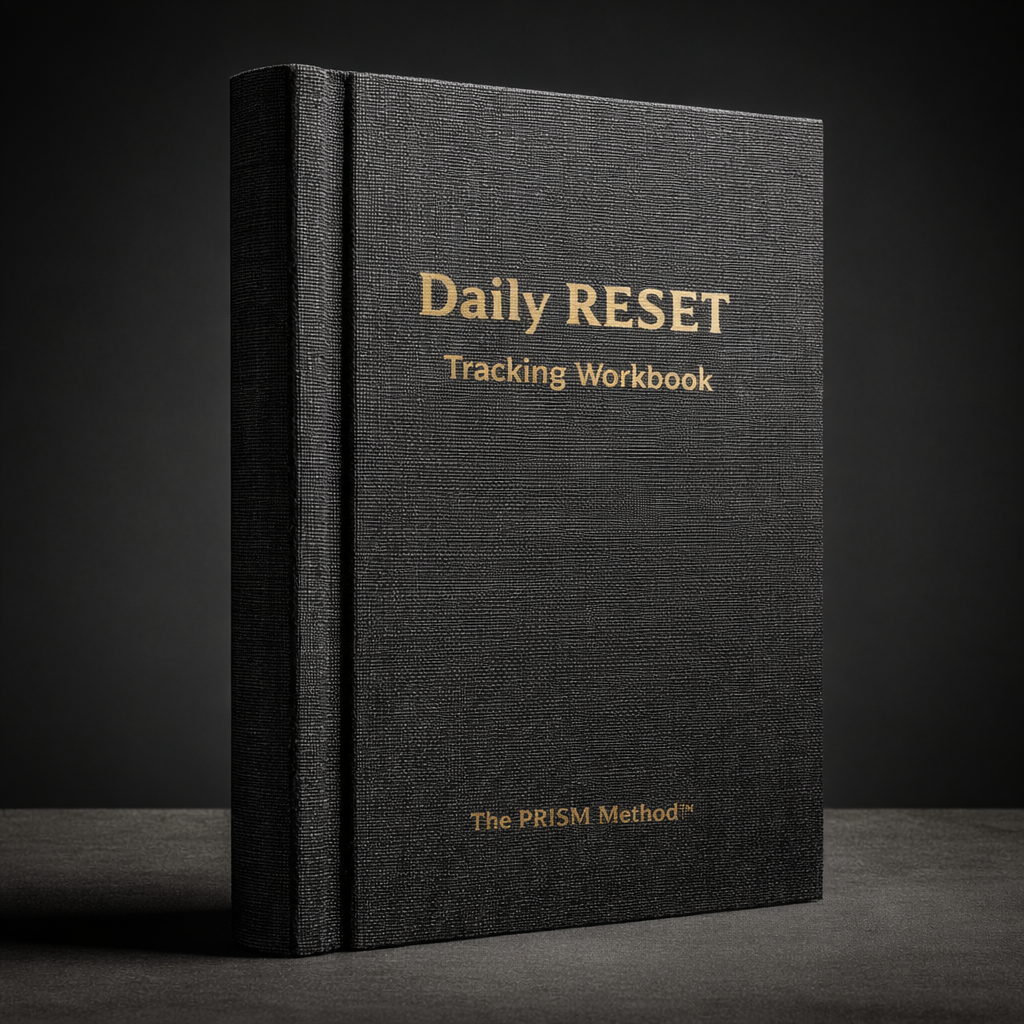
The Daily RESET Tracking Workbook
Value: $57
This is where the recalibration becomes visible — in black and white, undeniable even to a brain that’s been discounting evidence for years. Morning prep, RESET Protocol entries, weekly analysis.
For a demographic that lives by metrics — this is how you measure a mind changing.
Bonus #3
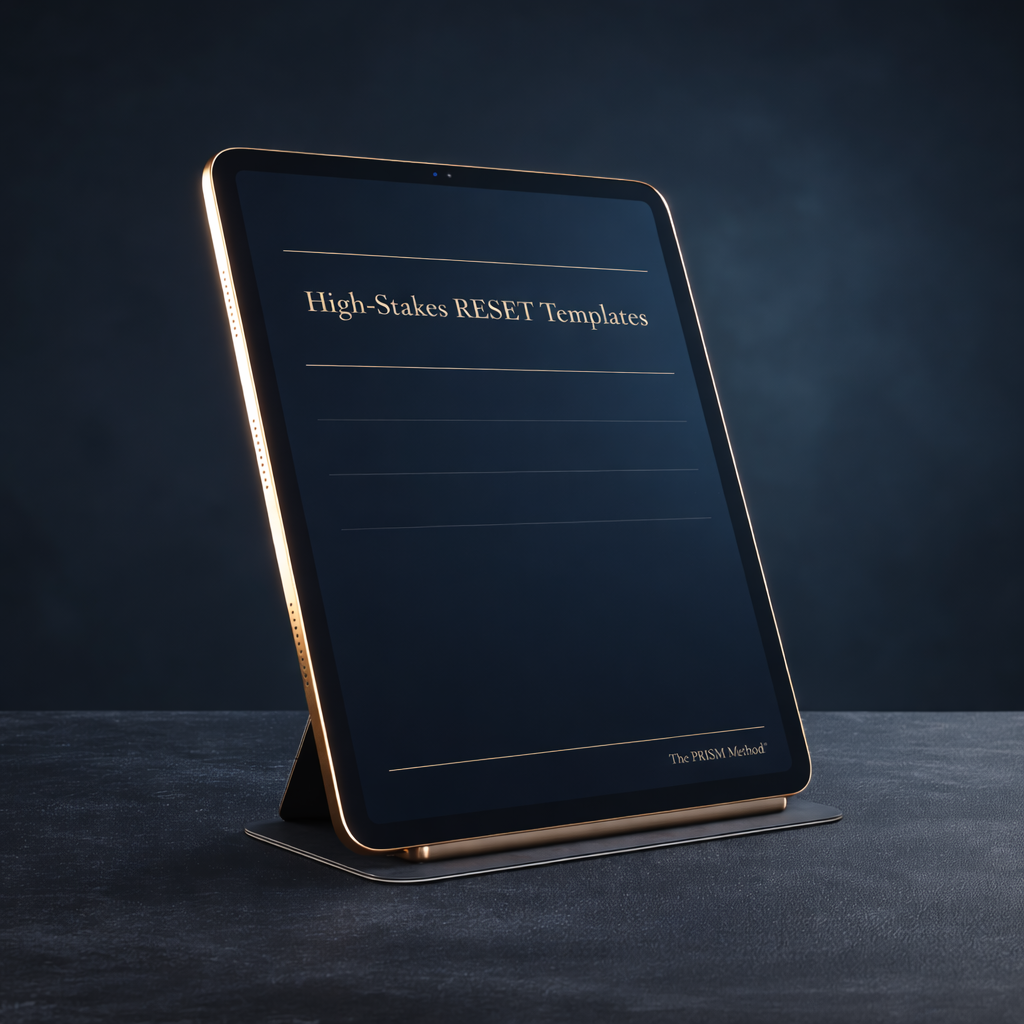
The High-Stakes RESET Templates
Value: $67
Five pre-built RESET frameworks for the exact situations where imposter syndrome does the most damage — presentations, performance reviews, new responsibilities, team leadership, and professional networking.
This is the tool you reach for at 7:50am when the meeting starts at 8:00.
Bonus #4
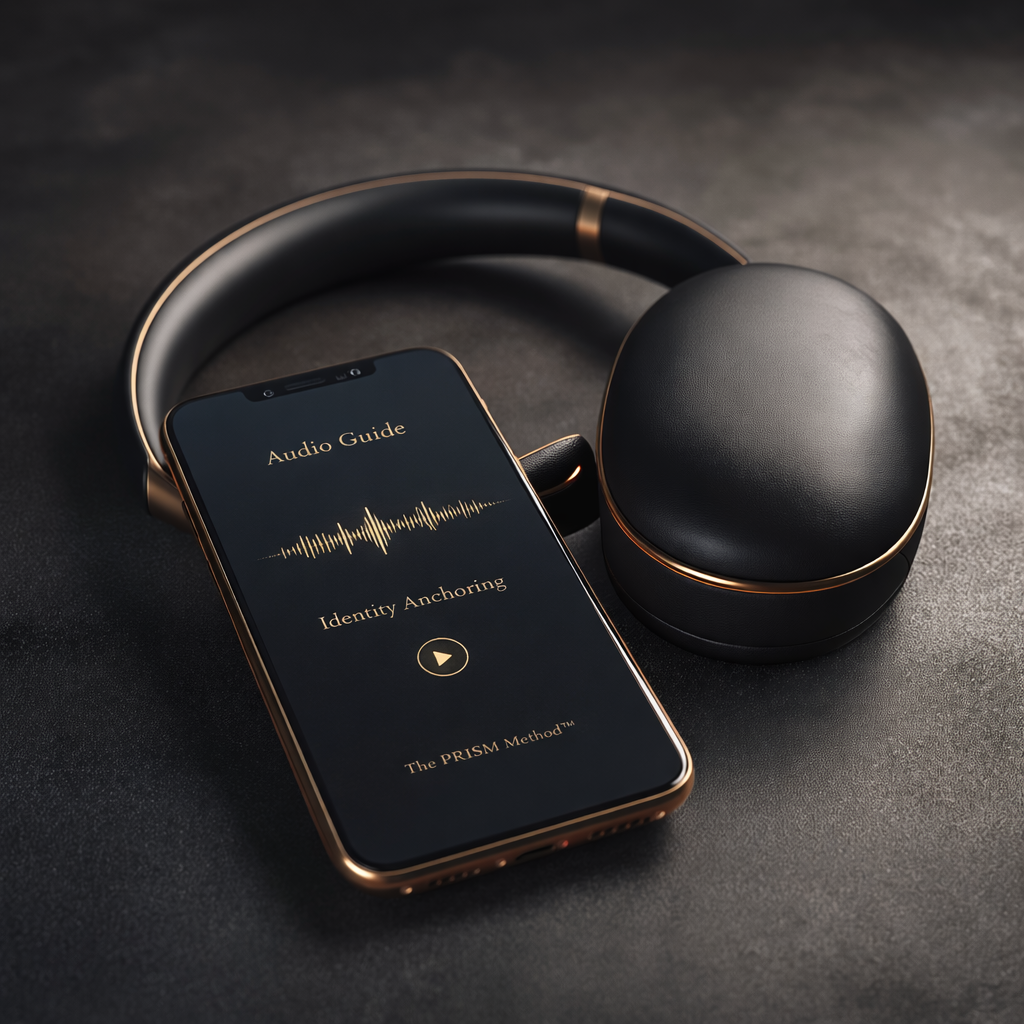
Audio Guide: Identity Anchoring (10:45)
Value: $47
A 10-minute guided session that reconnects you to your professional foundation — your values, track record, and documented capabilities — and anchors it as a felt physical reality before the moment demands it.
Members report using this for years after completing the program.
Bonus #5
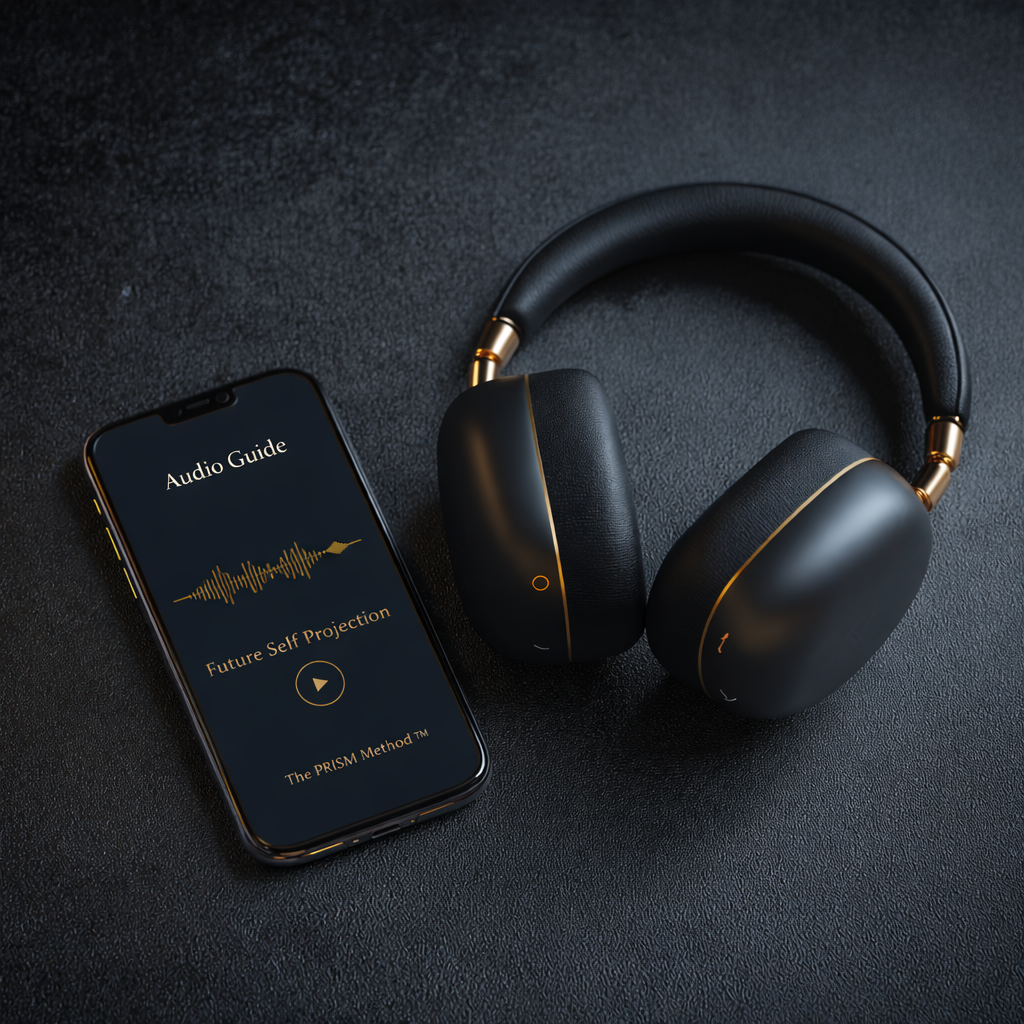
Audio Guide: Future Self Projection (12:59)
Value: $47
A 13-minute guided session that takes you forward into the professional identity you’re building — from the inside. Step into your future self, experience six specific shifts, then walk back to the present carrying that clarity.
You with fewer limitations. This session makes that version neurologically accessible right now.
Bonus #6
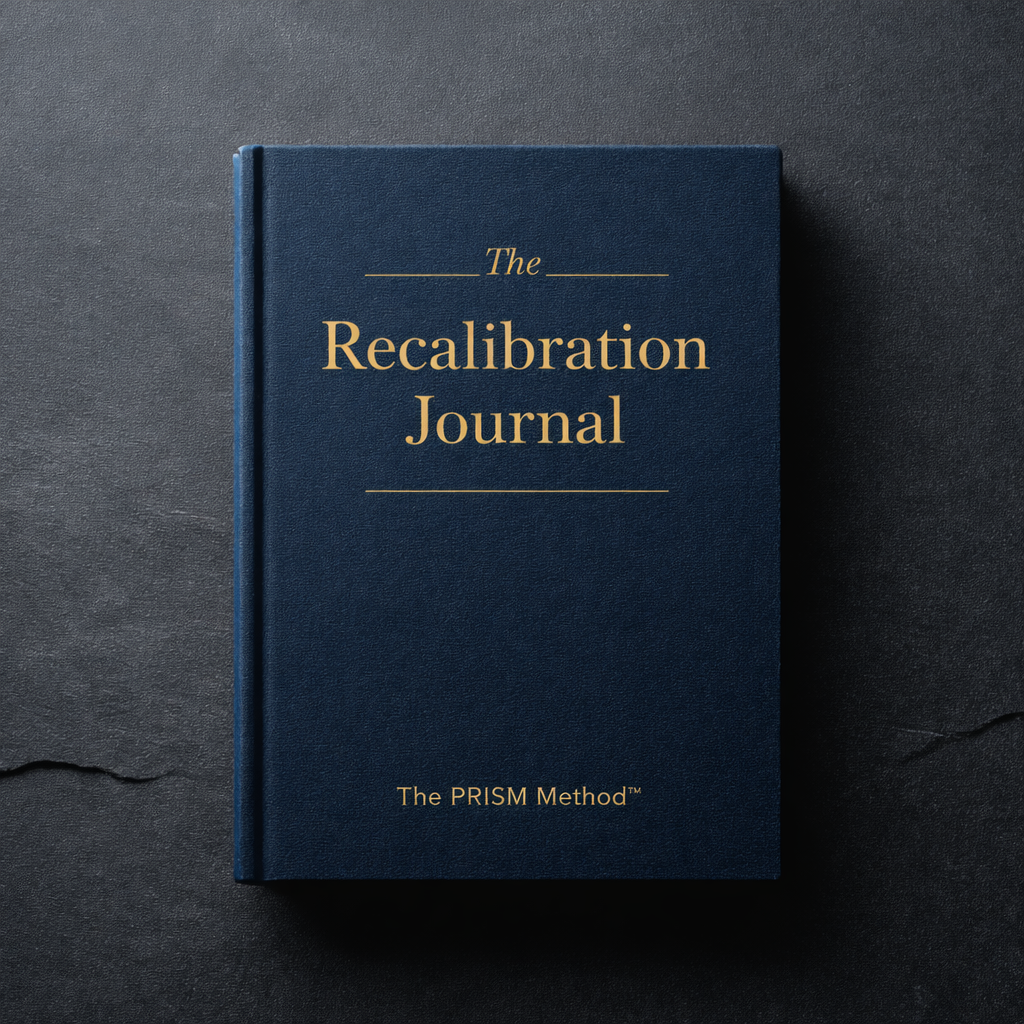
The Recalibration Journal
Value: $37
14 daily entries written specifically for each day’s program content. Every reflection ties directly to what you just learned, so insights consolidate instead of evaporating. Daily confidence scoring creates a visible record of your progress. Three months of post-completion check-ins keep the gains intact.
14 days of your own handwriting, proving your thermometer was wrong all along.
Real Results From Real Professionals Who Were Exactly Where You Are
"Before PRISM, I'd been passed over twice for a role I was clearly qualified for. I was terrified that if I pushed for it, I'd seem arrogant and they'd realise I'd been fooling them all along. Six weeks after finishing the program, I had the conversation I'd been avoiding for three years. I'm now Senior Director of Engineering — with a $35,000 raise. The shift wasn't gradual. It was like a switch flipped around Day 9."
Senior Director of Engineering | Global Technology Company
"I knew I was underpaid. But every time I thought about negotiating, my stomach would drop. The voice said: 'You should be grateful you have this job at all. Don't push your luck.' Two weeks after finishing PRISM, I negotiated a $42,000 salary increase — a 30% raise. The ROI on this program is genuinely insane."
Marketing Manager | SaaS Scale-Up
"The 3am spirals were destroying me. I'd wake up in a panic convinced I was about to be exposed as incompetent. After Day 7 of PRISM, they just... stopped. It's been three months and I've slept soundly every night. I genuinely didn't believe that was possible for someone like me."
Attorney | Corporate Law Firm
"I was promoted to VP and my imposter syndrome got ten times worse, not better. Board meetings terrified me. PRISM helped me understand why success intensified the feelings — and more importantly, how to reverse that. Now I actually look forward to leading high-stakes situations. I didn't think I was capable of that."
VP of Operations | Healthcare System
"I had read every book on this topic. I knew the 5 types, the cycle, the research — everything. But knowing didn't change anything. PRISM was different because it actually gave me a system to REWIRE the pattern. Not understand it more — rewire it. That's the distinction no other program makes."
Product Manager | Fintech Company
"As one of the few Black women in a leadership position at my company, I was never sure whether I felt like an imposter because of internal patterns or because I was navigating real bias — probably both. PRISM addressed both dimensions. The Identity Anchoring audio guide alone was something I came back to every single week. This is the only program I've seen that doesn't treat those two things as separate conversations."
Director of Finance | Fortune 500
"I'm a CEO. I've struggled with imposter syndrome for fifteen years. I thought it would fade as my track record grew. Instead it intensified every time the stakes got higher. PRISM was the first approach that actually worked — and I've tried all of them. If you're leading at a high level and still feel like you're winging it, this is for you."
CEO | Management Consulting Firm
"30 minutes a day sounded like a lot given how stretched I was. But I realised I was losing 3–4 hours a week to over-preparing and second-guessing. The first week of PRISM reclaimed more time than it cost. By week two, I'd given a company-wide presentation I would have avoided at all costs six months ago."
Data Scientist | Research Institute
"The PRISM Method™ represents a meaningful advance in how we can address imposter syndrome in professional contexts. By combining metacognitive recalibration work with sleep consolidation principles, it targets the mechanism — not just the symptoms. This is what structured intervention in this space should look like."
The Questions You're Probably Asking Right Now — Answered Directly
I've tried everything. What makes this different?
Most solutions help you understand or manage imposter syndrome. The PRISM Method™ is the first structured program built to address the mechanism — the Calibration Gap and the Protection Paradox — rather than surface symptoms. Therapy gives you insight. Books give you language. Workshops give you community. The PRISM Method™ gives you a step-by-step system to actually rewire the pattern, using targeted practice consolidated through sleep. That's a categorically different intervention.
Can 14 days really make a lasting difference on something this deep-seated?
We're not claiming to end all self-doubt in 14 days. We're giving you a research-backed system to recalibrate the measurement error and dismantle the protective behaviors that have kept it locked in place. The 14 days create the neuroplastic foundation. The tools you build last a lifetime. Think of it like learning to ride a bike — after 14 days, you know how. The muscle memory doesn't disappear.
I don't have time for another thing on my plate.
We hear this a lot — and there's a precise irony in it. A significant chunk of the time you don't have is being consumed by imposter syndrome: the over-preparation, the procrastination, the hours spent second-guessing yourself. Professionals who complete The PRISM Method™ report reclaiming an average of 5–10 hours per week by ending the over-preparation cycle alone. The 30-60 minutes per day for 14 days isn't adding to your burden — it's the investment that reduces it. Permanently.
What if I actually am not good enough and this is just accurate self-assessment?
This is the fear at the center of imposter syndrome — and it deserves a direct answer. Here it is: if you had genuinely been faking it for years, statistically, you would have been exposed by now. One of those projects would have crashed. One of those presentations would have failed spectacularly. One of those managers would have figured you out. That hasn't happened — because you're competent. Your assessment system is just reading you inaccurately. The PRISM Method™ begins with a Personal Impact Assessment on Day 1 that will show you, in concrete terms, exactly where your internal thermometer is reading low versus where genuine growth areas exist. It's not about false validation. It's about accurate measurement.
What if people find out I'm working on this?
The program is entirely private and digital. No group calls. No public commitments. No one needs to know. And consider this: 71% of CEOs experience imposter syndrome. The most successful leaders in the world invest in their psychological performance. Doing this work doesn't expose a weakness — it demonstrates the kind of self-awareness that distinguishes exceptional leaders from merely competent ones.
What if it doesn't work for my specific situation?
The underlying mechanism — the Calibration Gap and Protection Paradox — is universal across industries, seniority levels, and professional contexts. Whether you're in healthcare, technology, law, finance, academia, or creative fields, your brain's internal assessment system can be miscalibrated and your protective behaviors can be keeping it stuck. The PRISM framework includes context-specific application modules so you're not working with generic principles — you're applying them directly to your workplace scenarios.
The $97 seems low for something this comprehensive — is this legitimate?
The program was priced deliberately at $97 for the launch period because the mission is access, not exclusivity. High-end coaching programs addressing imposter syndrome charge $1,500–$5,000. The PRISM Method contains the same research-backed framework at a fraction of the cost, in a format that's more consistent and more intensive than bi-weekly coaching calls. And it comes with a full 20-day money-back guarantee — so the only risk is 20 days of your time. If it doesn't deliver, we refund everything.
What if my imposter syndrome is connected to real systemic bias (not just internal patterns)?
This program explicitly addresses both dimensions. The Identity Anchoring and Future Self Projection audio guides are particularly effective for rebuilding your sense of professional legitimacy after encounters with bias, while the High-Stakes RESET Templates give you structured tools for the specific moments where both dynamics are likely to collide. This is not a program that tells you it's all in your head.
One-time payment. No subscription. No recurring charges.
Here's What Happens If You Don't Act On This Right Now
Let's be straightforward about what waiting costs.
Right now, imposter syndrome is costing you an average of 10 full days of productivity per year to over-preparation alone.
Right now, it's costing you money — potentially tens of thousands of dollars per year in salary you haven't negotiated for, promotions you haven't pursued, opportunities you've handed to less qualified colleagues.
Right now, it's costing you sleep. Energy. The ability to be present with the people you love.
And here's the thing about the Escalation Paradox: it doesn't plateau.
The higher you climb — and you will climb — the more intense the fear becomes. The more there is to lose. The more witnesses there are when you're "found out."
If you don't address this mechanism now, your next promotion will make it worse. Your next success will raise the stakes. Five years from now, you'll still be waking up at 3am — except now you'll have a VP title and a corner office, and the voice will have even more ammunition.
The Cost of Waiting
Every year unaddressed, the pattern compounds. Here is what that looks like.
Index
52% of professionals have already turned down at least one opportunity
The gap is open. Every avoided negotiation compounds from here.
The promotion you talked yourself out of applying for.
3 more opportunities declined. 30 days of productivity lost to over-preparation.
$22,500–$75,000 in foregone compensation.
The salary negotiation you rehearsed but never had.
62% of directors report feeling like impostors. The pattern has escalated with every promotion.
$37,500–$125,000 in foregone compensation. 50 lost productivity days.
The leadership role you watched a less-qualified colleague take.
71% of senior leaders still affected. 12% have already left jobs they loved because of it.
$75,000–$250,000 in lost compensation. 100 days of productivity gone.
A decade of decisions made from fear instead of ability.
This $97 launch price is available for the first 500 members only.
Once that threshold is reached, the price returns to the normal retail price of $799.
Think about where you want to be in one year.
Do you want to be the professional who finally negotiated what they were worth? Who took the leadership role with confidence instead of dread? Who looks back at this moment and thinks: "That was the decision that changed everything"?
Or do you want to be exactly where you are right now — just twelve months older, with twelve more months of evidence that the pattern isn't going away on its own?
The PRISM Method™ can't make that decision for you.
But it can make sure that if you choose to act, you have everything you need to change this — for good.
The 20-Day Money-Back Guarantee
Your investment is 100% protected.
Try The PRISM Method™ completely risk-free for the full 20 days. Do the exercises. Apply the framework to your specific workplace scenarios and triggers. If you don't experience:
...simply email us ([email protected]) within 20 days of purchase for a full, 100% refund. No questions asked. No forms to fill out. No awkward explanations required.
You have nothing to lose except the constant fear of being found out.
What Life Looks Like On The Other Side
In 7 days
Most members report that the 3am anxiety spirals have become less frequent — or stopped entirely. You'll complete your first set of recalibration exercises, and the problem will finally make complete logical sense. Not as a personality flaw. Not as a weakness. As a measurement error that has a specific, workable solution.
In 14 days
You'll have a complete, personalised recalibration toolkit. You'll have practiced each technique enough times that your brain has started building new neural pathways. You'll receive praise and find yourself less compelled to deflect it. You'll speak up in a meeting without the usual internal debate. The shift won't feel theatrical or forced. It will feel like the fog is finally lifting.
In 30 days
You'll take at least one significant career action you've been avoiding. A salary negotiation. A promotion conversation. A high-visibility project you'd normally decline. Based on our data, 92% of members do this within 60 days — most within the first 30.
In 6 months
You'll look back at how you were operating before PRISM and wonder how you sustained it for so long. The constant background noise of "you're not good enough" will have been replaced by a more accurate, more balanced internal voice. One that lets you enjoy your success instead of fearing you'll lose it.
In 12 months
Imposter syndrome won't be running your career decisions anymore. It may still whisper occasionally — that's normal, and The PRISM Method™ prepares you for that too — but you'll have the tools to recognise the miscalibration, account for it, and move forward anyway.
You'll be earning more. Leading more confidently. Sleeping through the night.
And you'll finally feel like the professional you've always been.
You're One Click Away From Starting This
Everything You Get Today
The complete recalibration system — ready the moment you enrol.
One-time payment. No subscription. No recurring charges.
Here's exactly what happens when you click:
- You'll be taken to a secure checkout page (all major cards accepted)
- Complete your purchase — it takes less than 60 seconds
- Within 2 minutes, you'll receive a confirmation email with your personal login credentials
- You'll have immediate access to the full program, the Daily PRISM Field Guide, both audio guides, all worksheets and templates, and the Recalibration Journal — everything is in your private member dashboard, ready to go
Start with the Day 1 Personal Impact Assessment today. Begin the full program when you're ready. The program is self-paced within the 14-day structure.
One-time payment. No subscription. No recurring charges.
Frequently Asked Questions
One-time payment. No subscription. No recurring charges.